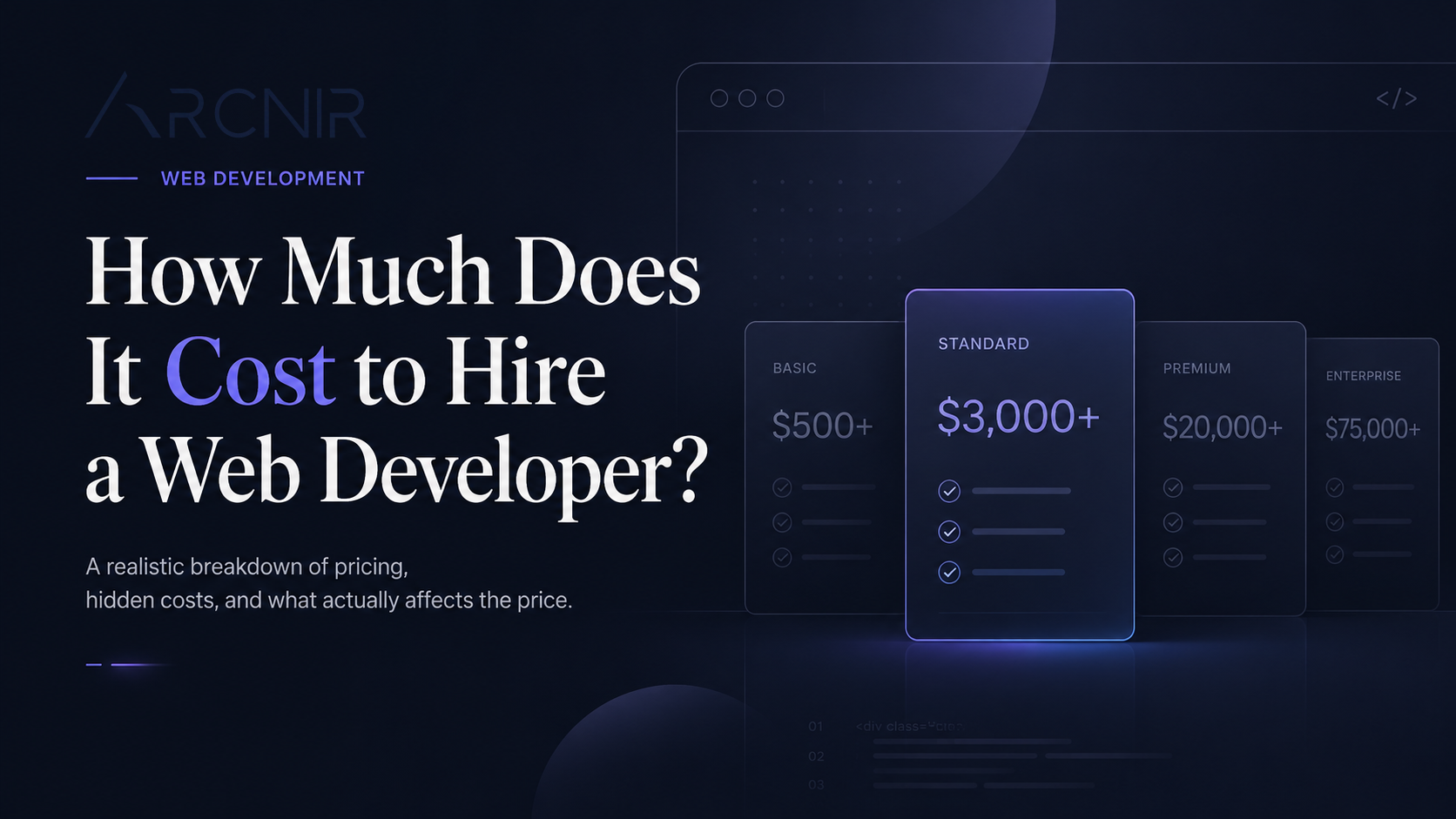
How much does it actually cost to hire a web developer? The honest answer: it depends, but here's a real breakdown of pricing, hidden ongoing costs, and what to watch out for before you hire anyone.
How Much Does It Cost to Hire a Web Developer?
If you've ever Googled this question, you've probably found a range so wide it's almost useless "$500 to $50,000+" and walked away more confused than before. So let me give you something more honest: a real breakdown from someone who actually builds websites and apps for a living, including the things most developers won't tell you upfront.
The Biggest Mistake People Make About Web Development Pricing
Most people treat websites like they're all the same thing. They're not.
The mistake I see constantly is people comparing websites the way they'd compare two chairs — as if every website takes roughly the same effort, the same time, and the same skill to build. That's like comparing a folding camping chair to a handcrafted leather executive chair and asking why the price is different.
A website for a local bakery that just wants to show up on Google is a completely different project from a website that handles live inventory, customer orders, payment processing, and a management dashboard. And even within something as "simple" as a small business website, the goal changes everything. Are you using it for SEO and lead generation? Brand visibility? Direct sales? Appointment bookings? Each of those pulls the project in a different direction.
And that's before we even talk about what happens under the hood, UI/UX design, loading speed, hosting infrastructure, database costs, uptime reliability, API integrations, query limits, domain registration. A website isn't an interactive poster. It's a living, technical system that needs to be maintained.
When someone thinks the pricing is unfair, it's almost always because they don't see the full picture of what they're actually paying for.
What I Ask Before I Ever Give a Price
Before I quote a single number, I need to understand your business. Here's what I actually ask:
- Do you have an existing website, or are we starting from scratch?
- What does your business do, and who is your customer?
- What is the purpose of this website or brand visibility, SEO, lead generation, direct sales, or internal business management?
- Do you need booking or reservation functionality?
- Do you need a payment gateway?
- Will customers be ordering from you directly through the site?
The answers to these questions determine everything. I need to understand your business inside and out before I can build something that actually works for you.
A Real Example: The Client Who Didn't Know What "Backend" Meant
I'll share a real project (keeping the client anonymous) because it illustrates exactly why pricing conversations need to happen honestly upfront.
A client came to us needing a shop website and not just a storefront, but with a live dashboard and a dynamic backend to manage what was being sold and at what price in real time. We built it using React, Next.js, and Tailwind. The development went well.
The problem came after launch.
The client didn't realize he needed to pay an ongoing subscription fee to keep the backend database live and running. He decided he didn't want to pay for ongoing maintenance after the project was done. So we handed it over and stepped away.
A few months later, his website stopped working. The database subscription had lapsed. He called us back, we came in on a separate contract, fixed the situation, and set up a proper maintenance plan.
The lesson here isn't that the client was foolish; it's that some costs are completely independent of the developer. The hosting has to be paid. The database subscription has to be active. The SSL certificate has to be renewed. These aren't optional extras. They're what keep the lights on.
What Does It Actually Cost? Realistic Price Ranges
Since I want to be honest about my own experience level, I've combined my real-world perspective with researched industry data to give you ranges you can actually use.
| Type of Project | Typical Range |
|---|---|
| Simple landing page (brochure/SEO) | $500 – $3,000 |
| Small business website (5–10 pages) | $2,000 – $8,000 |
| E-commerce store | $5,000 – $20,000+ |
| Custom web app or business management tool | $15,000 – $75,000+ |
| Ongoing maintenance retainer | $100 – $500+/month |
These are general market ranges based on industry data - every project is scoped individually and priced based on your specific needs. The right number for your project depends entirely on what you're trying to build and achieve.
From what I've seen working with clients so far, the majority of small business owners aren't looking for a custom management system. Most of them want what matters most right now: to be found online, to look credible, and to grow. They want brand visibility and SEO. The business owner who's been running things on a notepad and an Excel sheet for 20 years isn't looking to digitize their entire operation overnight — they want a professional presence that helps them compete.
That said, there's a growing group of younger, modern business owners who do want the full digital infrastructure. And for them, the investment is absolutely worth it.
How I Price My Work
Here's exactly how I structure my pricing, because I think transparency builds trust:
1. Fixed project rate upfront - based on an agreed scope of work. You know what you're getting and what it costs before we start.
2. Hourly rate if scope expands - if we go beyond the agreed number of revisions or features, hourly rates kick in. No surprises, because we agree on this before the project starts.
3. Monthly maintenance retainer - for clients who want ongoing support, updates, bug fixes, and monitoring.
4. First month free — after every project, the first month of maintenance and bug fixes is included at no charge. It's my way of standing behind the work I deliver.
If a client feels the price is too high, we don't just walk away. We sit down and look at the scope together, we can work around the features, revision rounds, or extend the timeline to bring the cost down. There's almost always a middle ground.
The Hidden Costs Nobody Talks About
This is the part that catches most clients off guard. Here are the ongoing costs you need to budget for after your website is built:
- Domain renewal: typically $10–$20/year
- Hosting subscription: $10–$100+/month depending on the server
- Database subscription: essential if your site has dynamic data (like our client learned the hard way)
- SSL certificate: some hosts include it, others charge separately
- API costs: if your site uses Google Maps, payment processors, or email services like SendGrid, those have monthly fees
- Security updates: outdated code is a vulnerability
- Bug fixes: things break, especially after platform or browser updates
- Backups: automated backup services protect you if something goes wrong
- Performance monitoring: tools that track uptime and loading speed
- Content updates: if you can't do it yourself, someone has to
None of these are developer fees. They're the cost of keeping a real, functioning website alive on the internet.
Why Not Just Use Wix or Squarespace?
It's a fair question. And for some businesses, a template builder is genuinely fine to start.
But here's how I think about it: a custom website is like a suit of armor, custom-forged to fit your business perfectly. No one wants to go into battle in armor that doesn't fit. No one wants to close a deal in a suit that doesn't fit either.
What we build is that custom suit of armor — with the right weapons attached. It fits your business, your customers, your goals. Template builders give you armor that was made for someone else and modified slightly. It works, but it was never made for you.
Custom development gives you performance, flexibility, and a digital presence that actually reflects your business — not a theme a thousand other companies are also using.
Red Flags When Hiring a Web Developer
While you're evaluating developers, watch out for these warning signs on both sides:
Red flags from clients (things that signal a difficult project):
- Asking for price before explaining what they need
- "I just need something simple" - then adding features throughout the project
- Comparing professional rates to $50 Fiverr quotes
- No clear vision, but strong opinions about what they don't like once it's built
- "We'll pay more once the business grows" - this is never a good sign
Red flags from developers:
- No written contract or scope of work
- Can't explain what technology they're using or why
- No portfolio or real examples
- Won't discuss ongoing maintenance or hosting
The Real Cost of NOT Having a Good Website
We're living in the age of the internet and AI. The people who are your customers right now, the younger generation, the ones with buying power and they don't ask their neighbours for recommendations. They Google it. They ask ChatGPT. They ask Claude. And from those results, they make a decision.
I'll be honest, I'm one of those people. When I need a service, I search for it online, see what comes up, and build my opinion from there. If a business doesn't show up, or shows up with a website that looks like it was built in 2009, I move on.
A good website with solid SEO means you show up when people are looking for exactly what you offer. Add a real-time chat or AI integration, and you reduce response time and make your business feel modern and accessible. All of this helps grow and modernize a business and not just for the tech-savvy owner, but for any business owner who wants to stay competitive in a world that has moved online.
The cost of a bad website — or no website — is invisibility.
Summary: What to Expect When Budgeting for Web Development
- A simple landing page: $500 – $3,000
- A proper small business website: $2,000 – $8,000
- E-commerce: $5,000 – $20,000+
- Custom web app: $15,000+
- Monthly maintenance: $100 – $500+/month
- Ongoing platform costs (hosting, domain, database, APIs): budget $50–$300+/month depending on your site
Again — these are industry-wide reference points, not a price list. Your project will be scoped and quoted based on exactly what your business needs.
The right developer will ask about your business before they ever mention a number. They'll give you a clear scope of work in writing. And they'll be honest with you about what keeping your site running actually costs — not just what it costs to build it.
If you're ready to talk about what your business actually needs, contact us here and let's figure out the right solution together.